If your business is considering solar, the Section 12B tax incentive is one of the most compelling financial arguments for acting sooner rather than later. It allows you to deduct the full cost of a qualifying solar installation from your taxable income in the year the system is commissioned, not depreciated over several years. For a profitable business, this can cut the effective cost of a solar system by 27% or more in year one.
What is Section 12B?
Section 12B of the Income Tax Act allows businesses to claim a 100% deduction on assets used to generate electricity from solar PV, provided the system does not exceed 1 MW in generation capacity. The deduction is applied in the year the asset is brought into use, meaning the full capital cost reduces your taxable income immediately.
This is significantly more valuable than normal wear and tear allowances, which spread the deduction over multiple years. With Section 12B, a business that spends R2 million on a solar system can deduct R2 million from taxable income in year one, reducing its tax liability by up to R540,000 at a 27% corporate tax rate.
What Changed After February 2025?
It is important to understand the current landscape. Section 12BA, which offered an enhanced 125% deduction and was introduced as a temporary measure, was not renewed in the March 2025 Budget Speech. Any solar assets brought into use after 28 February 2025 are not eligible for 12BA.
Section 12B remains in place and continues to offer the 100% deduction. For most commercial and industrial businesses installing solar in 2026, Section 12B is the applicable incentive.
What Qualifies Under Section 12B?
To qualify, the asset must meet the following requirements:
- The system generates electricity from solar photovoltaic (PV) energy
- The generation capacity does not exceed 1 MW
- The asset is owned by the taxpayer claiming the deduction
- The asset is used in the production of income
- The asset is brought into use during the relevant tax year
The 1 MW limit applies per installation, not per business. A business with multiple sites can claim Section 12B on qualifying systems at each location, provided each system is under 1 MW.
How the Numbers Work
Consider a manufacturing business that installs a 500 kWp commercial solar system at a total cost of R4.5 million, commissioned in the 2026 tax year.
- Section 12B deduction: R4,500,000
- Tax saving at 27% corporate rate: R1,215,000
- Effective net cost of the system after tax: R3,285,000
- Payback period reduced by approximately 1.5 to 2 years
The deduction only has value if your business is profitable and paying tax. A business in a tax loss position cannot benefit from 12B in the current year, though the deduction can carry forward in some structures. Speak to your tax advisor to confirm your specific position.
Section 12B and PPAs: An Important Distinction
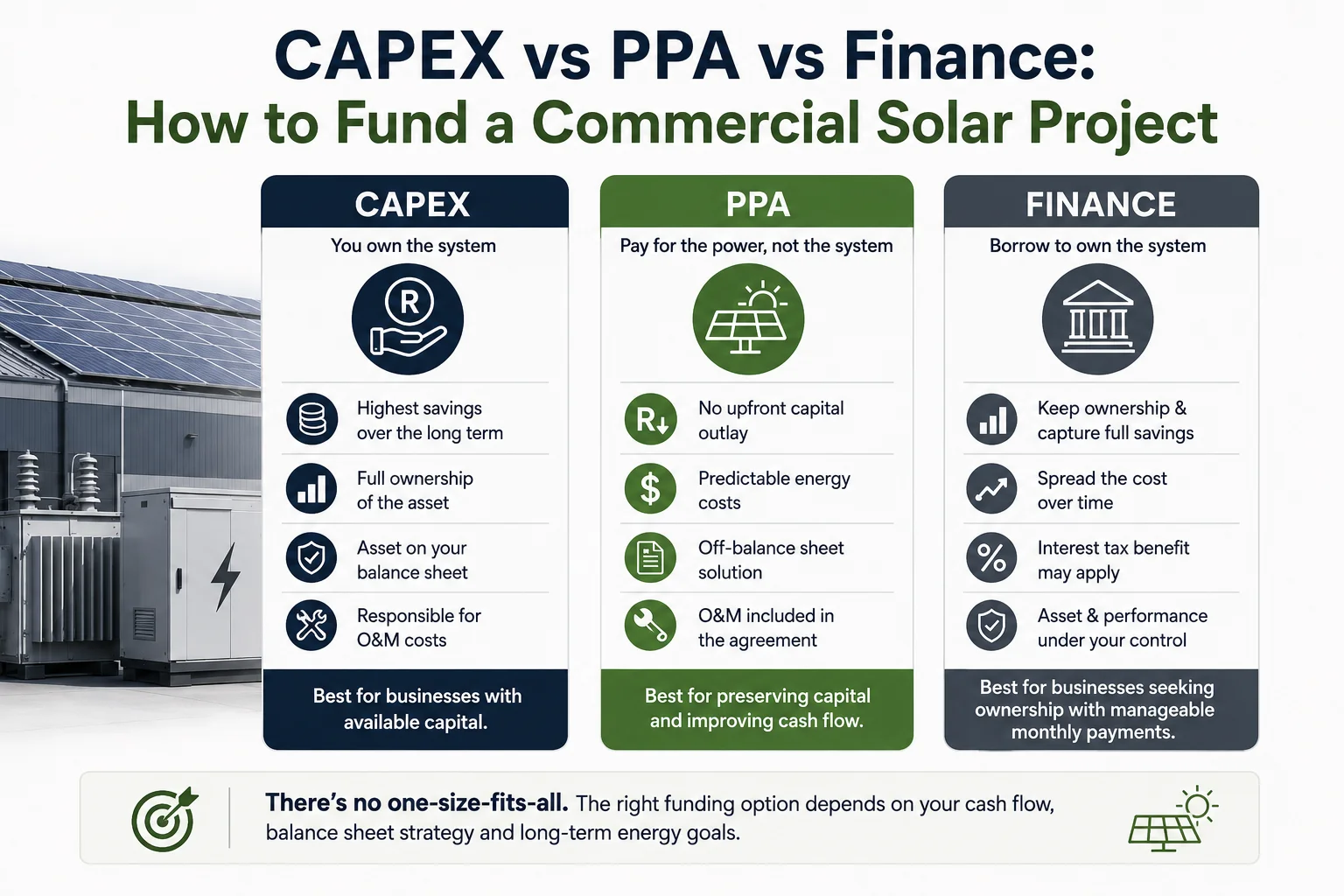
If your business finances solar through a Power Purchase Agreement (PPA) where a third party owns and installs the system, you cannot claim Section 12B. The deduction belongs to the asset owner, not the energy purchaser.
Under a PPA structure, the solar provider claims the tax benefit and typically uses it to offer you a lower per-unit energy tariff. The trade-off is that you do not own the asset, cannot claim the incentive directly, and are bound by a long-term contract, typically 10 to 20 years.
For businesses with available capital or access to asset finance, outright ownership combined with a Section 12B claim generally delivers a better financial outcome than a PPA over the life of the system.
Combining Section 12B with VAT
VAT-registered businesses can claim back the VAT component of the solar installation as an input tax credit. This is separate from the Section 12B income tax deduction and applies regardless of 12B eligibility.
For a VAT-registered business on a R2 million system, the VAT refund (at 15%) amounts to approximately R260,000. Combined with the Section 12B deduction, the effective cost reduction in year one can exceed 40% of the total system cost.
What to Do Next
Section 12B is straightforward in principle but the application depends on your business structure, tax position, and how the system is financed. Before proceeding, confirm the following with your accountant or tax advisor:
- Is your business in a taxable income position for the relevant year?
- Will you own the asset outright or through a finance agreement where ownership transfers to you?
- Does the system capacity fall under the 1 MW threshold?
- Is the commissioning date within the applicable tax year?
At Forest Energy, we work with businesses across South Africa to structure solar investments that make financial sense. Our proposals include a detailed financial model showing payback period, IRR, and tax deduction impact based on your actual electricity consumption and tariff. If you want to understand what a solar system would cost your business after tax, get in touch and we will run the numbers for you.