For most commercial and industrial businesses, the barrier to a solar and battery project is not the technology or the business case. It is how to pay for it. The good news is that there are three well-established ways to fund a commercial solar project, and the right one depends on your balance sheet, your tax position, and how much you want to own. Here is how they compare.
Option 1: CAPEX, buy it outright
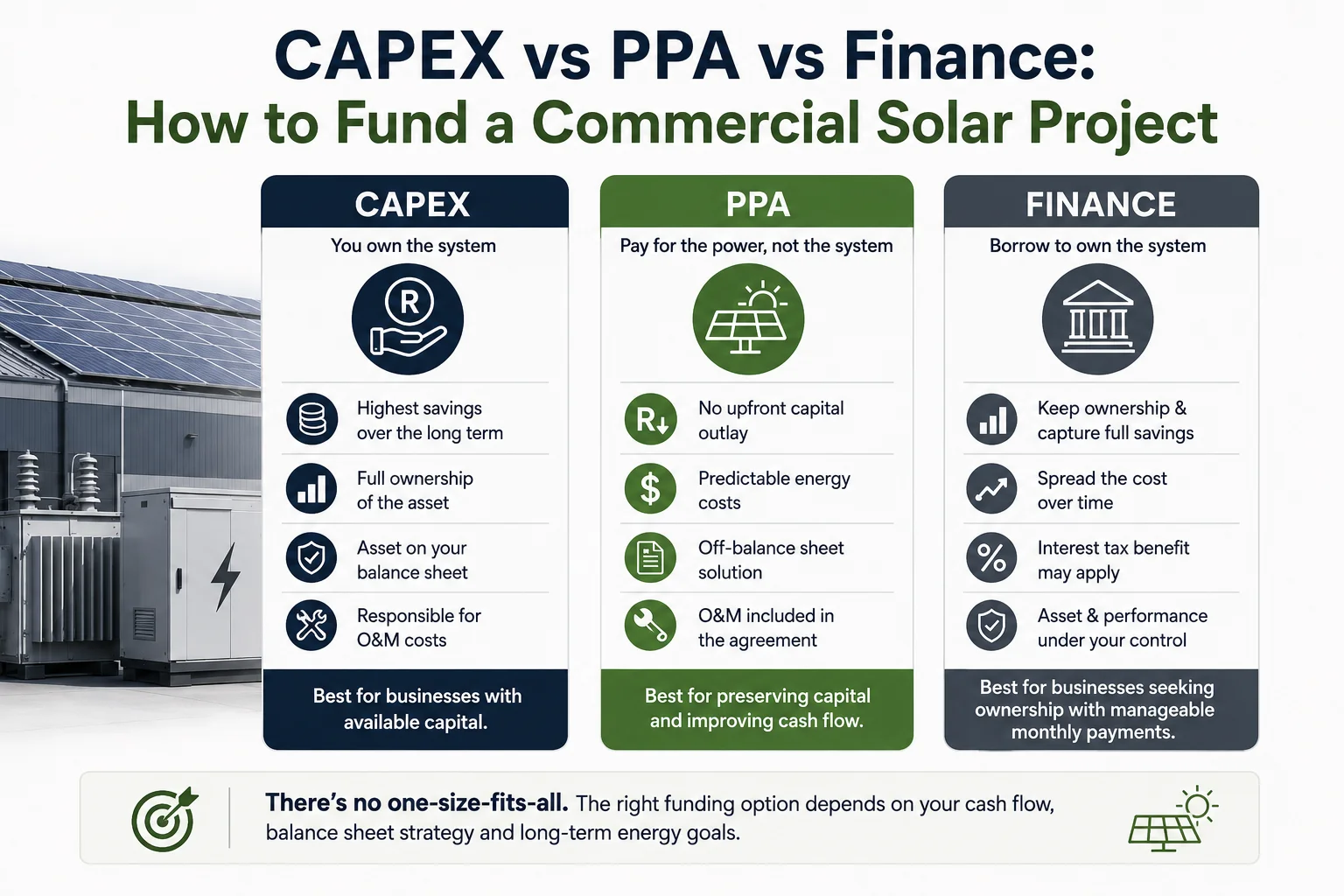
You fund the system from your own capital and own it from day one. This delivers the highest lifetime return because there is no financing cost eating into your savings, and every rand saved on electricity flows straight to your bottom line.
There are two further advantages in South Africa. You can claim the Section 12B accelerated depreciation allowance, which lets qualifying renewable assets be written off for tax, improving the after-tax return. And you carry no monthly repayment, so your cash flow improves immediately once the system is running.
The trade-off is the upfront outlay and the fact that capital is now tied up in an energy asset rather than in your core business.
Option 2: Finance, a loan or lease
You borrow to fund the system and repay over a fixed term while retaining ownership. This spreads the cost so that the monthly electricity saving can offset, or exceed, the repayment. You still benefit from ownership and, in many structures, the tax treatment, without the full upfront hit to cash.
This suits businesses that want to own the asset and capture the long-term savings but prefer to preserve capital for operations or growth. The return is lower than pure CAPEX because of the financing cost, but the project can be cash-flow positive from early on.
Option 3: PPA, zero upfront capital
Under a Power Purchase Agreement (PPA), Forest Energy funds, installs, and maintains the system, and you simply pay for the energy it produces at an agreed rate, typically below your current tariff. There are no upfront capital and no maintenance responsibility. You start saving from day one without the asset appearing on your balance sheet as a capital purchase.
The trade-off is that you do not own the system during the agreement, and the lifetime savings are shared with the funder. In exchange, you carry none of the capital risk.
How do these three funding options compare?
| CAPEX | Finance | PPA | |
|---|---|---|---|
| Upfront capital | High | Low to medium | None |
| Ownership | Immediate | Immediate | After term |
| Lifetime saving | Highest | High | High |
| Tax benefit (Section 12B) | Yes | Usually | No |
| Maintenance risk | Yours | Yours | Forest Energy's |
| Funding type | On balance sheet | On balance sheet | Off balance sheet |
Which one is right for you?
There is no universally best answer. A cash-rich business with a tax appetite maximises returns with CAPEX. A growth-focused business preserves capital with finance. A business that wants savings with zero risk and no capital chooses a PPA.
Forest Energy structures all three and models the after-tax numbers for each, so you can compare them side by side and take a clear recommendation to your board when you need to fund a commercial solar project.