
Gauteng is the industrial and commercial heart of South Africa, and it is also where rising electricity costs bite hardest. For commercial, industrial, and agricultural operations across Johannesburg, Ekurhuleni, and Tshwane, solar PV and battery storage have moved from a nice-to-have to a straightforward financial decision. Here is what matters before you invest.
Understand your tariff first
The single most important factor is the tariff you are on. Gauteng C&I sites are supplied either directly by Eskom, typically on a Time-of-Use (TOU) tariff such as Miniflex, or by a municipal distributor like City Power in Johannesburg, Ekurhuleni, or the City of Tshwane, each with its own TOU schedule.
TOU is important because peak-period rates can run several times higher than off-peak rates. That spread is the financial engine behind energy arbitrage, where a battery charges when power is cheap and discharges when it is expensive. Before sizing any system, your tariff and demand profile need to be understood, because they determine which solution actually pays.
Match the solution to the problem
Not every Gauteng site needs the same system:
- A business with high daytime consumption and a fast-payback goal is often best served by grid-tied solar (GridSolar).
- A site with expensive peak TOU rates gains more from solar combined with battery arbitrage (GridSolarBoost), which attacks both energy and demand charges.
- An operation that cannot tolerate interruption to critical processes needs a full hybrid system (HybridMax).
Choosing correctly is an engineering and financial exercise, not a catalogue decision. Our comparison of GridSolar, GridSolarBoost and HybridMax sets out where each one fits.
Space, capacity, and connection
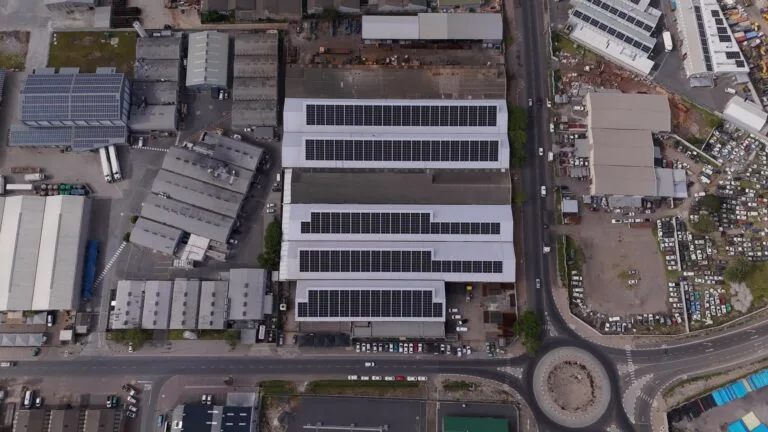
Gauteng sites vary from rooftop-constrained commercial buildings to industrial premises with ground space. Available roof or yard area sets the practical ceiling on solar capacity. Your Notified Maximum Demand (NMD) allocation matters too, particularly for sites looking to expand, because battery storage can add usable capacity without waiting on a grid upgrade.
How to fund commercial solar in Gauteng
Capital does not have to be the obstacle. Gauteng businesses can fund a project through outright purchase, finance, or a Power Purchase Agreement (PPA) with zero upfront capital. Each has a different effect on ownership, tax, and cash flow, and the right structure depends on your balance sheet.
A local team on the ground
Forest Energy has expanded its Gauteng presence and appointed Rohann Pace as Branch Manager to lead its commercial and industrial solar and battery work across the province. That means a local point of contact backed by the full engineering and financial modelling capability of the wider Forest Energy team.
What to do next
Pull your most recent electricity bill and identify three things: your tariff, the ratio of your peak to off-peak rate, and your demand charge. Those three numbers tell you quickly whether solar, battery arbitrage, or a full hybrid system is likely to deliver the strongest return on your site. From there, a proper model turns the estimate into a business case.