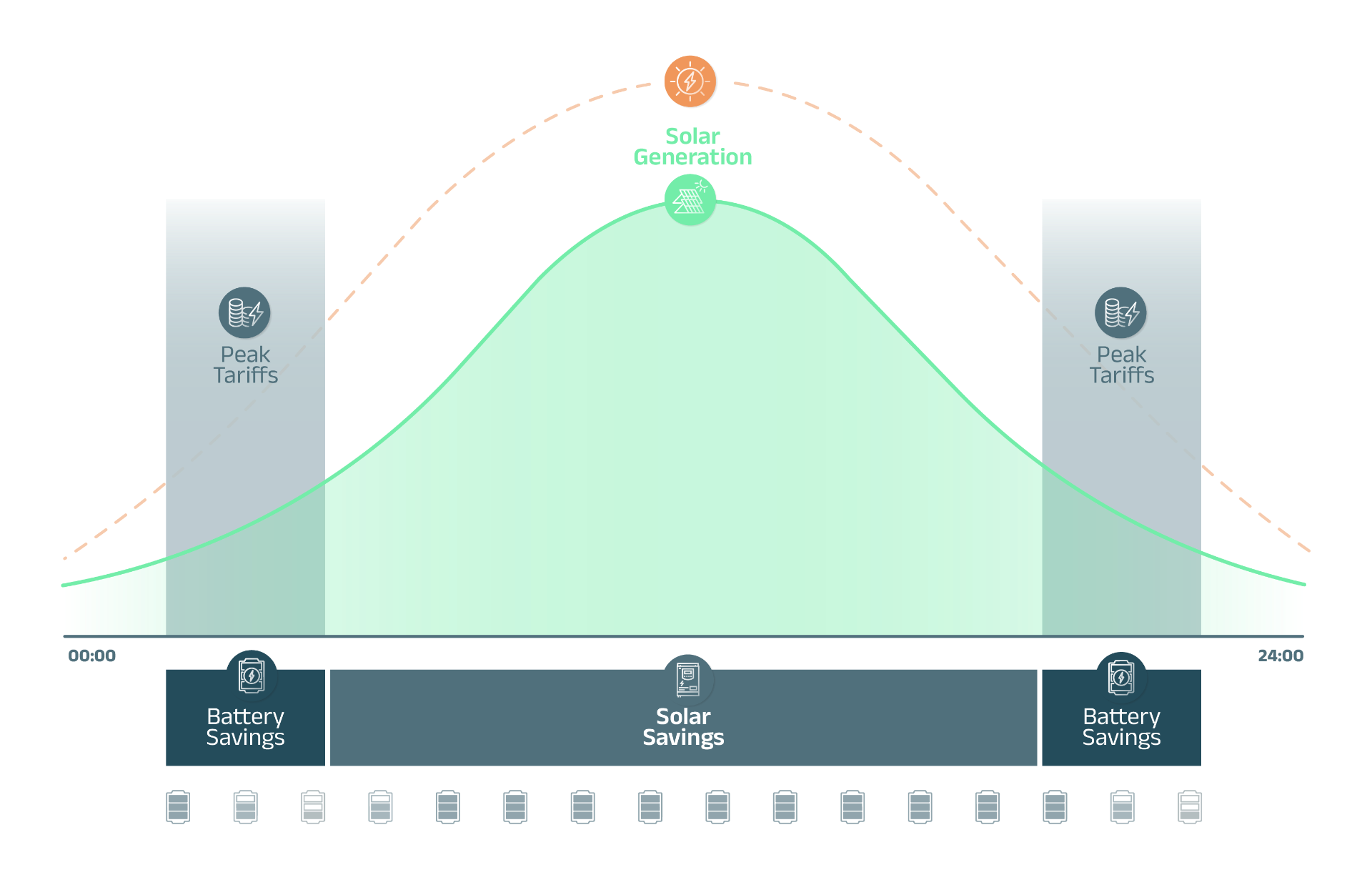
There are four ways to reduce what you pay in peak: shift load out of the peak windows, generate your own power during them, store cheap electricity and discharge it when the peak rate applies, and lower the demand reading that sets your fixed charges. For most commercial and industrial businesses on a Time-of-Use (TOU) tariff, the battery does the heavy lifting, and the rest of this article explains why.
First, understand what peak is costing you
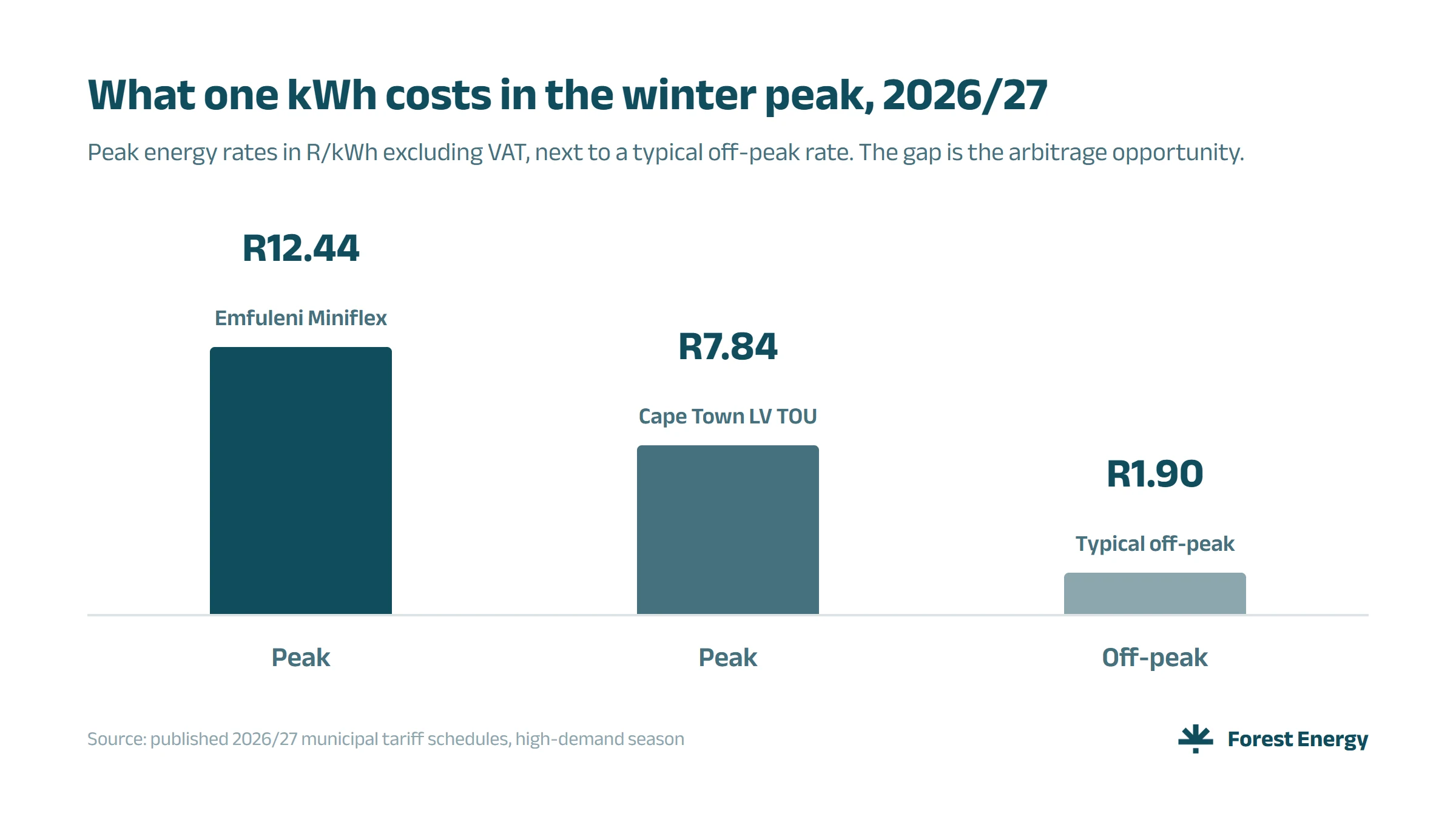
On a TOU tariff, the price of a kWh depends on when you draw it. Peak windows fall on weekday mornings and evenings, and in the high-demand season from June to August the peak rate is typically three to seven times the off-peak rate. These are published 2026/27 winter rates, excluding VAT:
| Tariff | Peak (R/kWh) | Off-peak (R/kWh) | Ratio |
|---|---|---|---|
| Emfuleni Miniflex (LV, under 1 MVA) | 12.44 | 1.69 | 7.4x |
| City of Cape Town LV TOU | 7.84 | 1.90 | 4.1x |
We have covered both tariffs in detail: the Cape Town LV TOU increase and the Emfuleni Miniflex peak rate. If your site is on a different tariff, the same logic applies, only the numbers change.
Option 1: Shift load out of the peak windows
The cheapest kWh is the one you move. Rescheduling energy-intensive processes, pumping, refrigeration pull-down, batch production or compressed air, away from the peak windows costs nothing but operational discipline. But look at what this option actually asks of you: it lets the tariff dictate when your business produces. The honest question is not what load shifting saves, it is how much business you lose by not operating during peak. If the morning peak window is also your most productive shift, avoiding it costs you more in output than it saves in electricity.
Option 2: Solar helps, but misses the evening peak
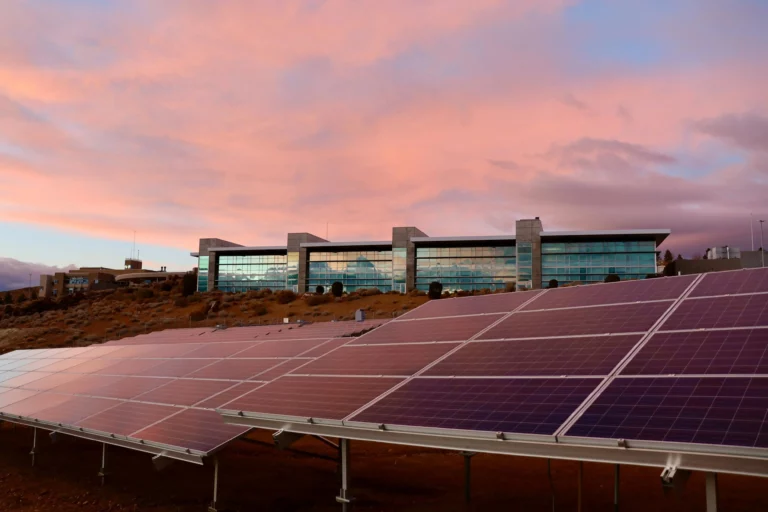
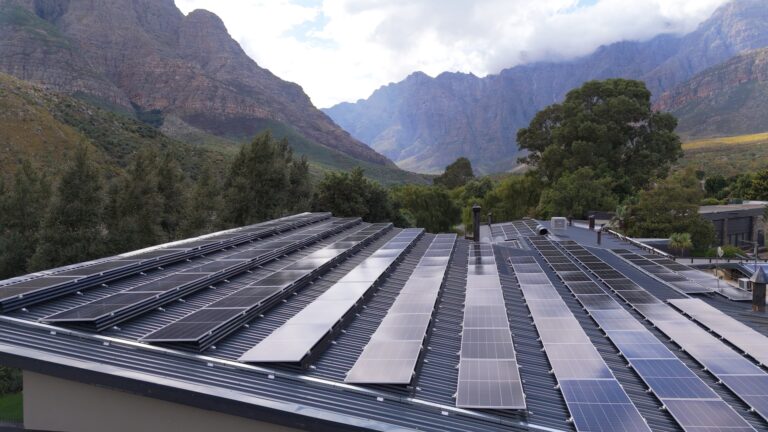
Solar PV offsets daytime consumption at a strong return, and for daytime-heavy operations it is the right first investment. But the peak windows sit in the early morning and evening, and in winter, when the peak rates are at their highest, the sun is not up for most of them. Solar alone reduces your bill. It does not deal with the peak rate problem.
Option 3: Store cheap energy and use it in the peak
This is the direct answer to the question. A Battery Energy Storage System (BESS) charges when electricity is cheap, overnight at off-peak rates or from your own solar during the day, and discharges through the peak windows when the grid price is at its highest. This is energy arbitrage, and the saving per shifted kWh is the gap between the two rates: R5.94 on Cape Town's LV TOU tariff and R10.75 on Emfuleni's Miniflex, every peak hour of every winter weekday.
This is what GridSolarBoost is engineered for: solar plus a battery sized and controlled for financial performance on your specific tariff. It is worth being clear about what it is not. A battery sized for arbitrage is not backup power, it is an arbitrage instrument, and it is sized to pay for itself.
The saving is only half the value. A solar and battery solution removes the trade-off that Option 1 forces on you: your operation runs when it needs to run, at full capacity, through every peak window, while the battery absorbs the tariff. You get the savings and the freedom to schedule production around your business, not around the electricity price.
Option 4: Cut the demand charges at the same time
Peak energy is only part of the peak problem. TOU tariffs also carry a demand charge and a network capacity charge billed on your kVA, and on most municipal tariffs those fixed charges are climbing faster than the energy rates. Because your site's maximum demand usually occurs during the peak windows, a battery that discharges through them lowers the kVA reading the utility bills you on. One asset, two savings.
One caveat: how much of this saving you can capture depends on your municipality. Some bill on your measured demand, which a battery reduces directly. Others charge on your registered Notified Maximum Demand (NMD) regardless of what you actually draw, so a site with a 1 MVA connection pays for 1 MVA even if it only ever uses half of that. Which rule applies, and whether your NMD can be formally reduced, is part of the tariff research Forest Energy does for every site before we model the business case.
Which option fits your site?
The right answer depends on your load profile and your tariff, and both are on your bill. Pull the most recent one and check three things:
- Your tariff name, and whether it is TOU. If you are on a flat rate, ask your utility what the TOU alternative looks like before investing in anything.
- How many kWh you draw in the peak windows each month. That number times the peak-to-off-peak gap is your arbitrage ceiling.
- Your billed kVA and Notified Maximum Demand (NMD). If your maximum demand lands in the peak window, a battery cuts this charge too.
Forest Energy models the business case from your metered consumption and your utility's published rates, not from averages. If you do not have interval data, Forest Insights installs billing-grade metering that shows exactly where your peak exposure sits.