
If your business is on the City of Cape Town's Low Voltage Time-of-Use (LV TOU) tariff, your electricity got more expensive on 1 July 2026. The winter peak energy charge is now R7.84 per kWh excluding VAT, up 7.5% from R7.29 last year. And the energy rate is not even the fastest-growing line on the bill. The demand charge is up 8.6%, the network capacity charge is up 8.9%, and the fixed service charge is up 8.6%.
The new rates at a glance
Here is the 2026/27 CoCT LV TOU tariff next to last year's rates, all excluding VAT.
| Charge | 2025/26 | 2026/27 | Increase |
|---|---|---|---|
| Winter peak energy (R/kWh) | 7.29 | 7.84 | +7.5% |
| Winter standard energy (R/kWh) | 2.35 | 2.49 | +6.0% |
| Winter off-peak energy (R/kWh) | 1.80 | 1.90 | +5.3% |
| Summer peak energy (R/kWh) | 3.44 | 3.67 | +6.7% |
| Summer standard energy (R/kWh) | 2.23 | 2.37 | +6.4% |
| Demand charge (R/kVA/month) | 234.69 | 254.76 | +8.6% |
| Network capacity, NMD (R/kVA/month) | 35.81 | 39.00 | +8.9% |
| Service charge (R/month) | 2 321.35 | 2 519.88 | +8.6% |
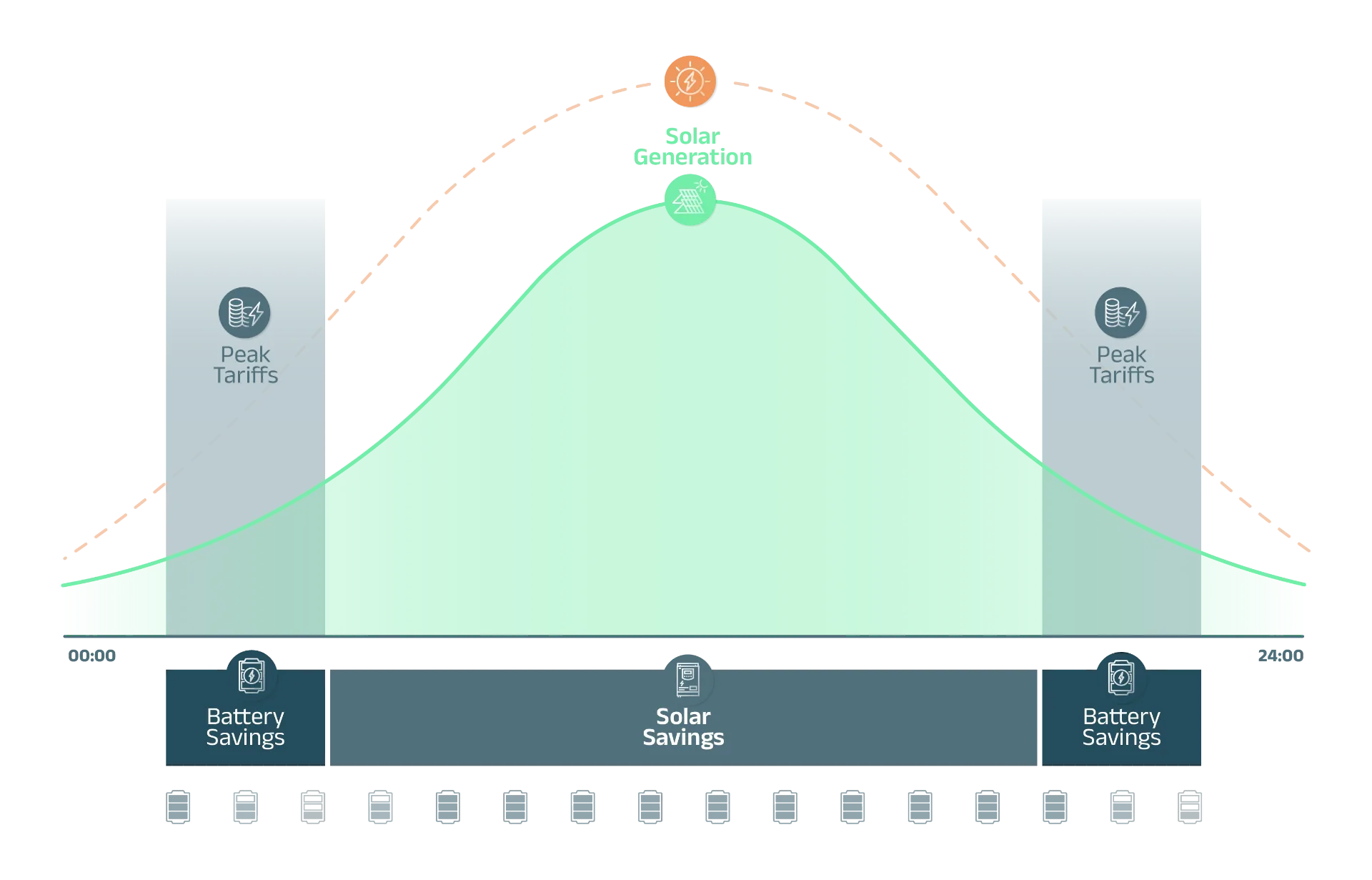
The number that matters most is the spread. The winter peak rate of R7.84 is more than four times the off-peak rate of R1.90. Every kWh your site draws from the grid during a weekday winter peak window costs over four times what the same kWh costs a few hours later.
The fixed charges are rising faster than the energy
Notice that the demand charge, network capacity charge and service charge all increased by more than any energy rate. These charges are billed on your peak kVA and your notified maximum demand, not on how much energy you use. Even if your consumption stays flat this winter, this part of your bill grows by close to 9%. Reducing it requires reducing your measured peak demand, which is exactly what a correctly configured battery does.
Why the spread is the opportunity
A peak rate four times the off-peak rate is the condition energy arbitrage is built for. A Battery Energy Storage System (BESS) charges when electricity costs R1.90 per kWh and discharges during the peak windows when the grid would otherwise cost R7.84. Every unit shifted this way saves R5.94 before VAT.
The battery earns twice on this tariff. Discharging through the peak window also lowers the kVA the municipality measures, which cuts the demand charge that just went up 8.6%. Solar handles the daytime load on top of that. The GridSolarBoost approach, solar combined with a battery configured for arbitrage, is designed for exactly this tariff structure.
What Cape Town businesses should do now
Pull your most recent City of Cape Town bill and check three things:
- Confirm you are on the LV TOU tariff and work out how much of your consumption falls in the winter peak windows.
- Note your peak-to-off-peak ratio. At more than four to one, the arbitrage maths is firmly in your favour.
- Check your billed kVA and notified maximum demand, because those charges rose faster than the energy rates and a battery can reduce both.
Forest Energy is headquartered in Cape Town and models the business case directly from your metered consumption and the City's published rates, so the payback and rand saving reflect your actual site, not an average.