Most commercial and industrial businesses read their electricity bill from the top: the rand-per-kWh energy charge. That is not where the hidden money is. On a Time-of-Use (TOU) tariff like Eskom Miniflex, a large share of your monthly cost comes from the demand charge, billed in kVA on your highest measured demand for the month. For many C&I sites, this single line runs to tens of thousands of rand and is almost never scrutinised.
What a kVA demand charge actually is
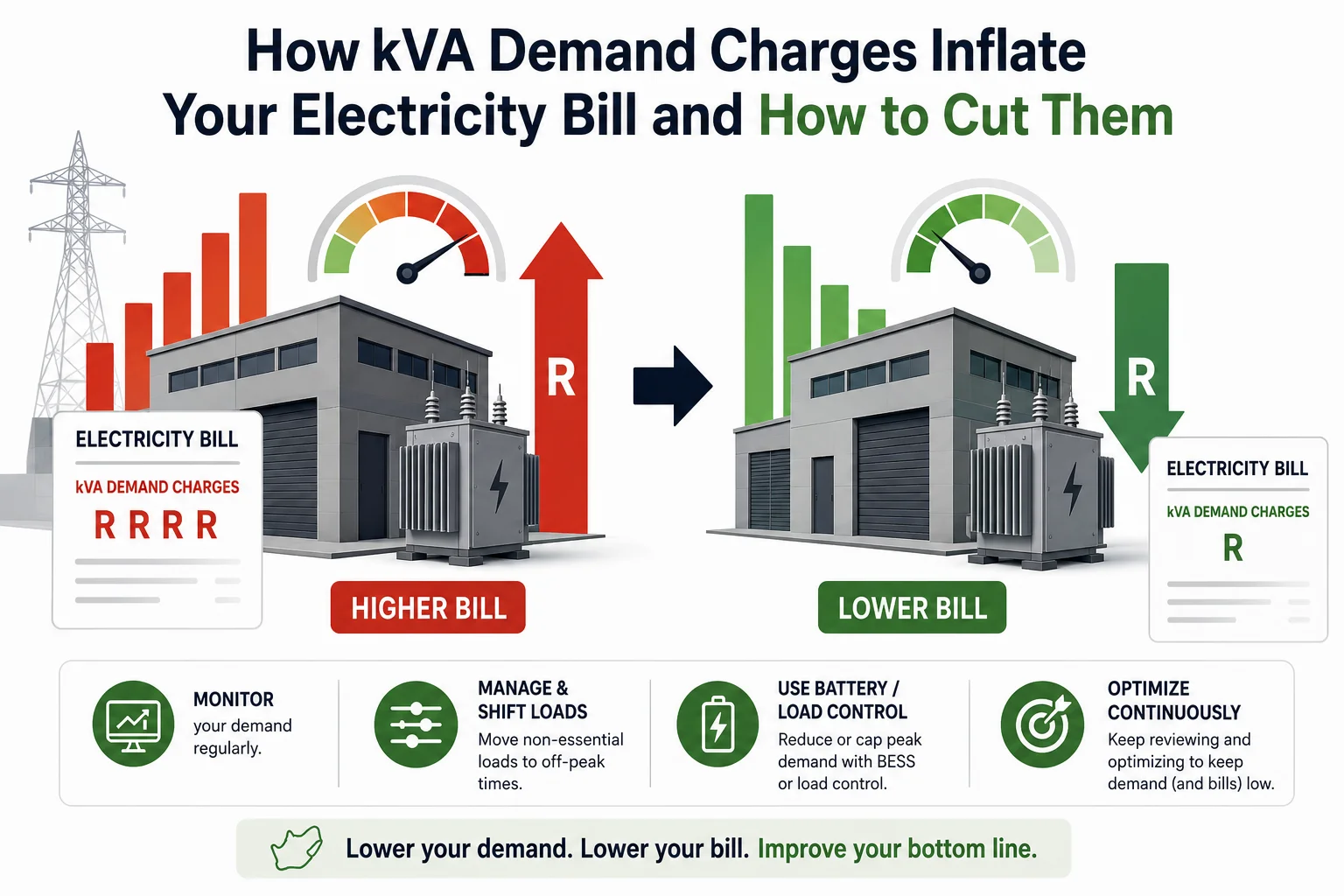
Your demand charge is based on the peak power your site draws in any measurement interval, usually 30 minutes, during the billing period. It is not about how much energy you use in total. It is about the sharpest spike. Start a few large motors at the same time on a Monday morning, and that single half-hour can set the demand charge for the entire month, even if the rest of your operation runs efficiently.
This is why two sites with identical monthly consumption can pay very different bills. The one with the spikier load profile pays more, sometimes far more.
Why solar alone does not fix it
Solar PV lowers the energy portion of your bill during daylight hours. It does very little for kVA demand charges because your peak demand often occurs early morning or evening, and because a passing cloud can drop solar output in seconds, right when a demand spike hits. Relying on solar to shave demand is unpredictable.
How battery peak shaving cuts the charge
A Battery Energy Storage System (BESS) is the correct instrument. Configured for peak shaving, the battery discharges precisely during your demand peaks, capping the power drawn from the grid. Instead of the grid seeing a sharp spike, it sees a flat, controlled profile. Your measured demand drops, and the demand charge drops with it.
A battery specified with enough reserve held back for peak shaving can also run energy arbitrage on top, charging during cheap off-peak periods and discharging into expensive TOU peaks. That combination needs a bigger battery than either job needs on its own, because the peak-shaving reserve only holds if it has not already been drawn down chasing arbitrage savings. GridSolarBoost is specced this way when the site's economics justify the larger system, otherwise Forest Energy sizes the battery around whichever saving matters most for your site.
The economics
Demand charge savings are measurable and repeat every month, which is what makes them attractive. To size the opportunity, pull three to six months of your interval data and look at how often your true peaks occur and how high they reach. A load profile with occasional sharp spikes is the ideal candidate, because a modestly sized battery can shave the peaks that are inflating the charge.
Forest Energy models this directly from your metered data, so the business case reflects your actual profile, not a generic assumption. The result is a payback period and rand saving you can take to your finance director.
What to check on your own bill
Find the demand charge line and the kVA figure it is based on. Divide it into your total bill. If kVA demand charges are a meaningful share of what you pay, peak shaving is worth modelling before you spend anything on generation you may not need.
One caveat: how much of the saving you can capture depends on your utility. Some bill on measured demand, which a battery reduces directly. Others charge on your registered Notified Maximum Demand (NMD) regardless of what you draw. Checking which rule applies to your site is part of the tariff work we do before modelling anything.