Energy arbitrage and peak shaving get used almost interchangeably by South African businesses shopping for battery storage, but they are not the same strategy. Mixing them up is how the wrong system ends up being specified for a site. Both use the same hardware, a Battery Energy Storage System (BESS) paired with an inverter, but they solve two different problems on two different lines of your electricity bill.
What energy arbitrage actually does
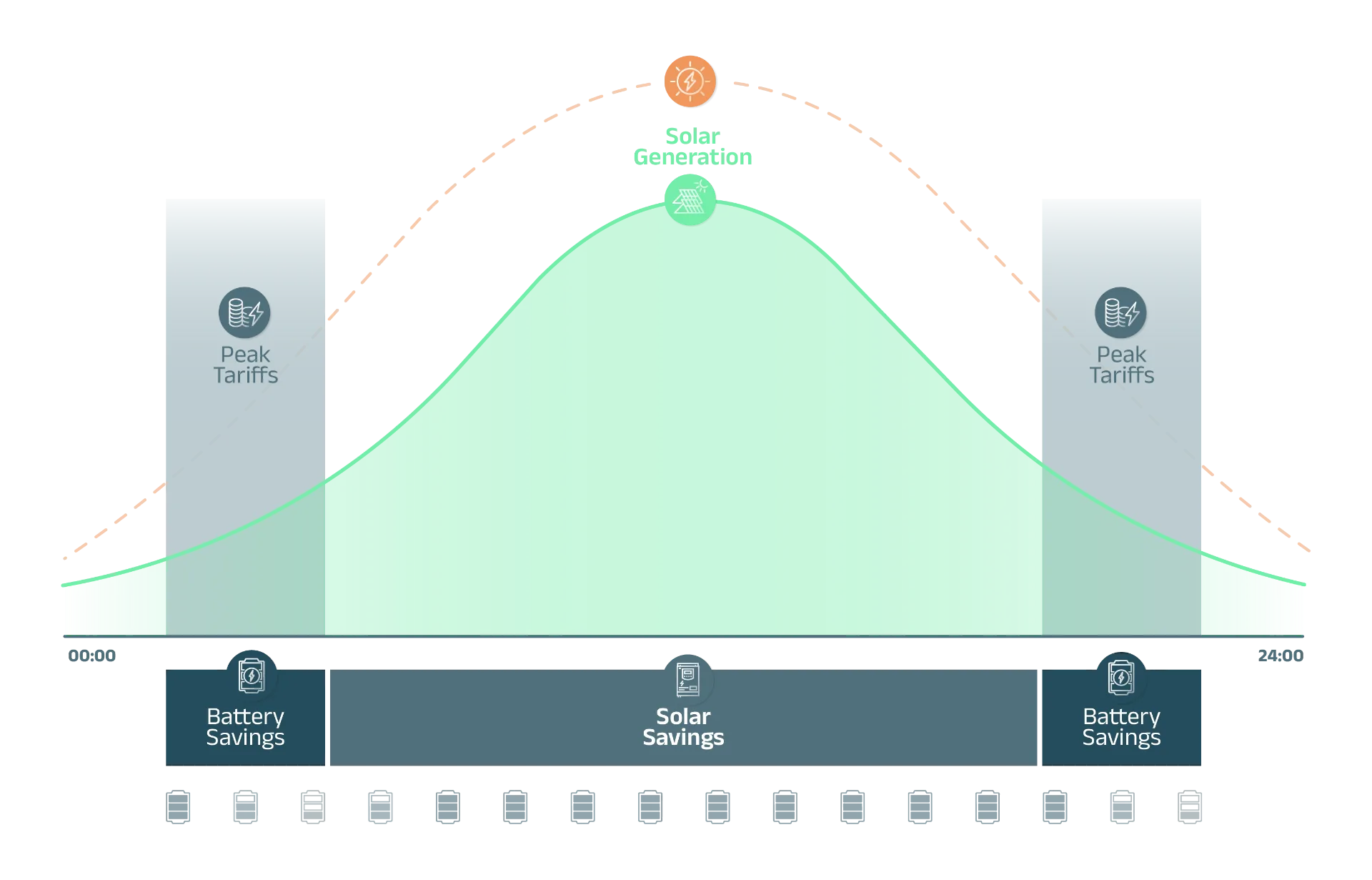
Energy arbitrage is a financial strategy built around the shape of a Time-of-Use (TOU) tariff. The battery charges when electricity is cheap, usually overnight or in the early morning off-peak window, and discharges when the grid would otherwise cost far more, during the TOU peak. On Eskom's Miniflex tariff, high-demand season peak energy costs R7.05 per kWh while off-peak drops to R1.18 per kWh, a spread of R5.87 per kWh. Every unit of consumption shifted from peak to off-peak captures close to that full difference.
To put the arithmetic in rand terms, a site that shifts 500 kWh a day from the Miniflex peak window to off-peak captures roughly R2,935 a day before battery losses and cycling costs are accounted for. That is the kind of number that gets an arbitrage business case taken seriously at board level, and it is why the size of the spread on your specific tariff matters more than the technology itself.
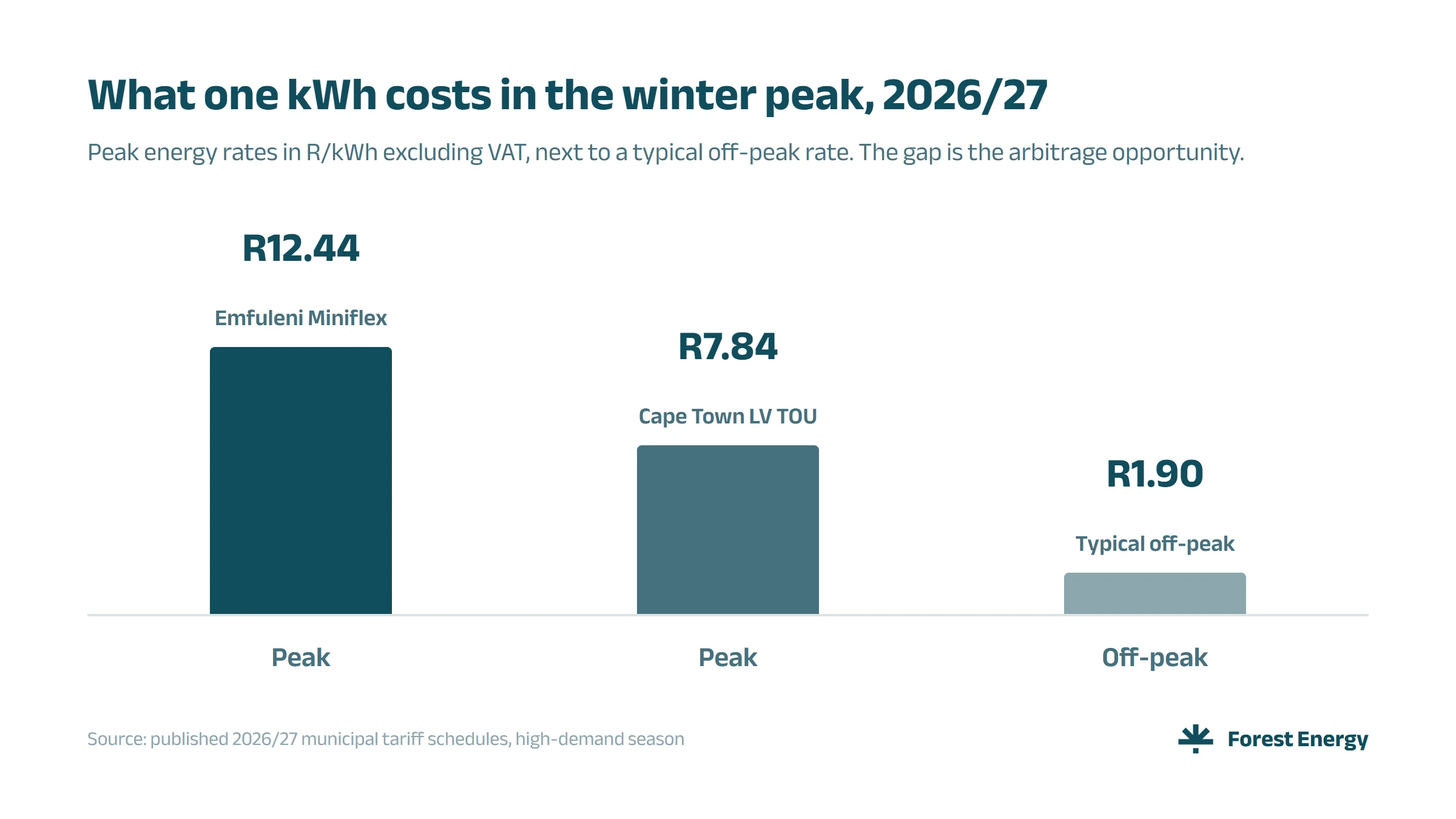
The bigger the spread on your tariff, the stronger the case for arbitrage. Some municipal tariffs push the spread even further. Emfuleni's Miniflex peak rate reached R12.44 per kWh in the 2026/27 tariff year, close to seven times its off-peak rate, which makes arbitrage one of the most valuable things a battery can do on that specific tariff.
What peak shaving actually does
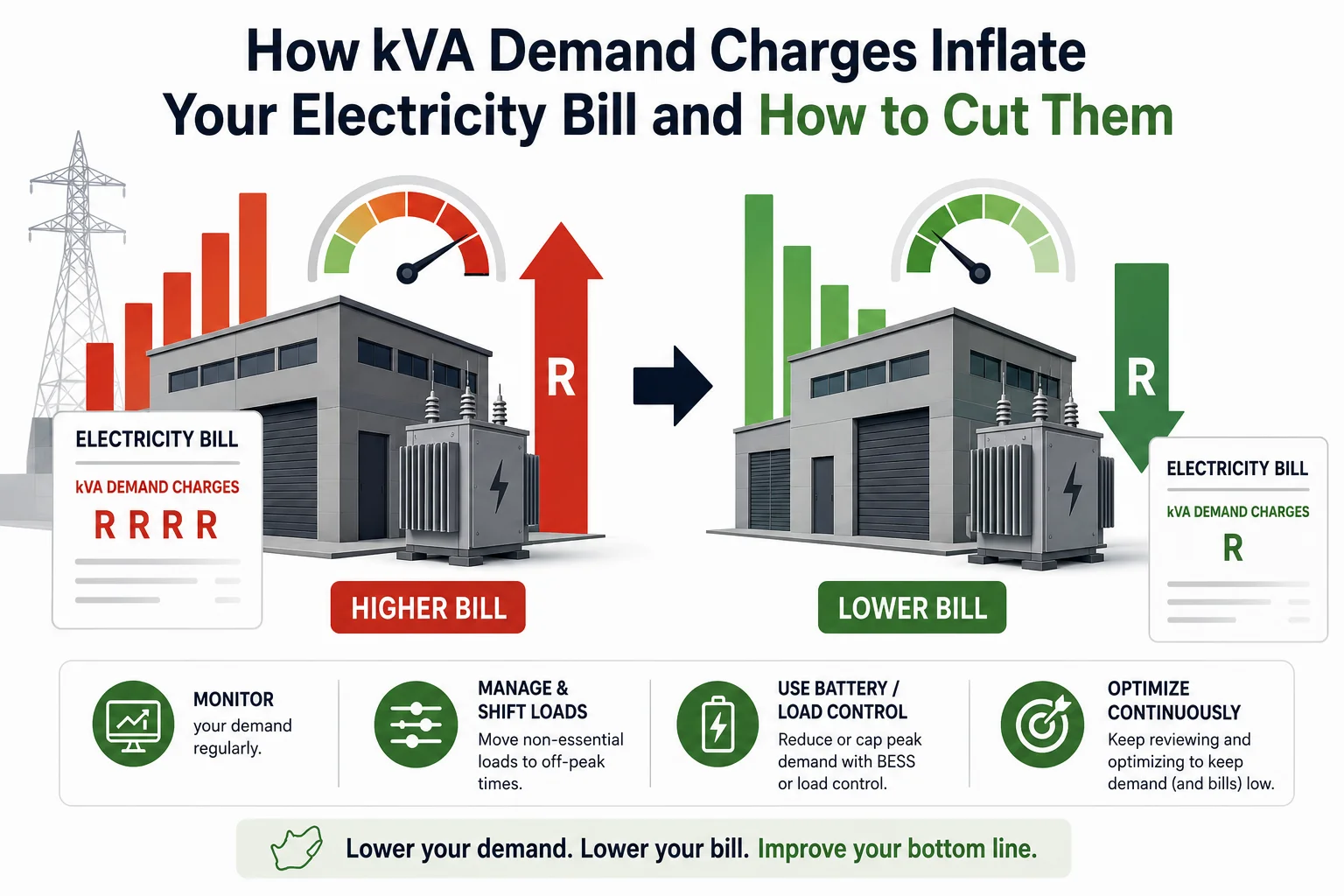
Peak shaving targets a completely different line, the kVA demand charge. Demand charges are billed on the single highest power draw your site records in any 30-minute interval during the month, not on how much energy you use in total. Two sites with identical monthly consumption can pay very different bills if one has a spikier load profile. For many commercial and industrial sites, this demand charge alone runs to tens of thousands of rand a month, and it is rarely scrutinised.
A battery configured for peak shaving discharges precisely when your site is about to set a new demand peak, capping what the grid sees at a flatter, lower figure. It has nothing to do with the time of day electricity happens to cost more. It is entirely about the shape of your load.
The core difference, side by side
| Energy arbitrage | Peak shaving | |
|---|---|---|
| What it targets | The R/kWh energy charge | The kVA demand charge |
| What triggers a discharge | Time of day, the TOU peak window | Your site approaching a new demand peak |
| What tariff it needs | A wide gap between peak and off-peak rates | Any tariff with a demand charge line |
| Typical saving | A share of the peak/off-peak spread on every shifted kWh | A reduction in one monthly demand charge line |
Why Forest Energy usually specs a system for one, not both
A single battery can technically run both strategies at once, but only if it is large enough to carry spare capacity for both jobs at the same time, generally a much bigger battery than either strategy needs on its own. That extra capacity costs money, so unless a site's economics justify the bigger system, Forest Energy specs a battery to prioritise one strategy over the other rather than oversize for both.
On a battery sized for one job, peak shaving only works if enough charge is held in reserve to guarantee a cap on the single highest demand reading that occurs anywhere in the billing month, not most peaks, the one that actually happens. If that reserve has been drawn down chasing arbitrage savings overnight or earlier in the day, and a demand spike hits while the battery is low, the site draws straight through the setpoint. The demand charge for the entire month is then set by that one spike, and the arbitrage savings captured earlier do not offset it.
This is why a system specified for arbitrage discharges more freely to capture the R/kWh spread, while a system specified for peak shaving holds back capacity so it can guarantee the cap. GridSolarBoost is engineered around whichever strategy is the stated priority for your site. Doing both properly on one system is possible, it just means specifying for the larger of the two jobs rather than assuming the smaller one comes free.
Solar PV is a separate lever again. It offsets daytime energy consumption but does very little for either arbitrage or peak shaving, because demand peaks often occur early morning or evening, outside strong solar hours, and a passing cloud can cut solar output in the exact moment a demand spike hits.
Which one should your system prioritise
If your site sits on a steep TOU tariff and consumes meaningfully during the evening peak, prioritising arbitrage usually delivers the bigger monthly saving, and the demand-charge risk is secondary. If your load profile is spiky, with occasional large motor starts or batch processes that send demand soaring for a few minutes, prioritising peak shaving protects against a single bad spike wiping out a month of arbitrage gains. Most commercial and industrial sites carry both problems in some proportion, which is why Forest Energy models both scenarios from your metered data before recommending which strategy the system should be built around.
One caveat applies to peak shaving specifically, and it is worth flagging rather than glossing over. Some utilities bill demand charges against your registered Notified Maximum Demand (NMD) rather than what you actually draw each month. On an NMD-billed site, a battery that reduces your measured peak does not reduce the charge, because the charge is fixed by your registered capacity, not your metered behaviour. Which rule applies to your site has to be checked before peak shaving savings are modelled, otherwise the projected saving will not show up on the bill.
What to check on your own bill before you decide
- Find the demand charge line and the kVA figure it is based on. Divide it into your total bill to see how much of your cost it represents.
- Check your peak-to-off-peak rate ratio on your TOU tariff. A ratio of four or more makes arbitrage worth modelling on its own.
- Pull three to six months of interval data if you have it. A spiky profile with occasional sharp peaks is the strongest case for peak shaving.
Forest Energy models both savings directly from your metered consumption and your utility's published tariff, so the business case reflects what a battery would actually do on your site, not a generic assumption. A properly commissioned system also needs ongoing operations and maintenance to keep delivering both savings for its full life, which is a separate line item worth budgeting for from day one.